
ORTHODONTICS

The Main Orthodontic Problems
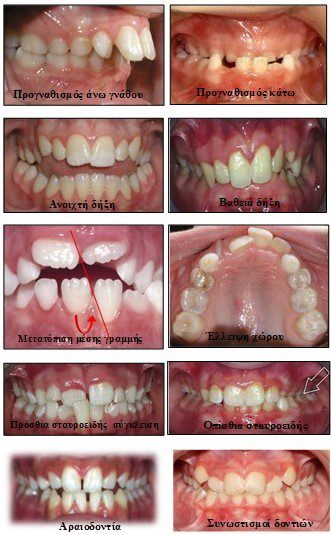
- Upper jaw protrusion: One of its characteristics is that the upper front teeth protrude excessively beyond the lower ones — the "buck teeth" as most parents describe them. This may be due to a skeletal problem, or a combination of dental and skeletal problems. Normally, the upper teeth should slightly overlap the lower ones and lightly touch them when the mouth closes.
- Lower jaw protrusion: One of its characteristics is that, when the mouth closes, the lower front teeth are positioned in front of the upper ones. This may be due to a skeletal problem or a combination of skeletal and dental problems.
- Open bite: When, on closing, the front and/or side teeth do not touch each other.
- Crossbite: When, on closing the mouth, the upper teeth are positioned further inward than the lower ones. This can occur on one or both sides. In many, more severe cases it is also combined with ENT problems such as adenoids and enlarged tonsils, and with symptoms such as snoring during sleep, mouth breathing, etc. It can also develop as a result of certain parafunctional habits (bad habits) such as thumb sucking, incorrect swallowing, or forward tongue thrust.
- Deep bite: When the upper teeth overlap the lower ones by more than 1-2 mm. Sometimes the lower teeth reach the palate, injuring its mucosa.
- Midline shift: When the midline of the upper teeth does not coincide with that of the lower teeth. This may be due to either dental problems (premature loss of a baby tooth) or skeletal problems.
- Lack of space: Lack of space prevents a tooth from erupting correctly into the mouth. It can result from the premature loss of a baby tooth due to decay, a mismatch between tooth size and the dental arches, etc.
- Spacing (gaps between teeth): When there are large gaps between the teeth due to a mismatch between teeth and jaws, missing teeth, etc.
- Crowding and rotation of teeth (Crowding): When the teeth are not aligned within the dental arch, due to lack of space or other causes.